



Updated: 2025-12-25
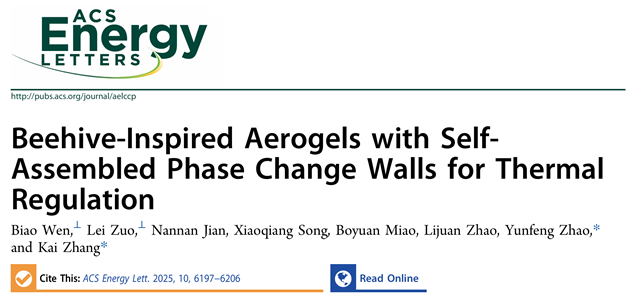
The soft matter mechanics team at the Beijing Institute of Technology (BIT) has achieved a significant breakthrough in the field of thermal management. Their findings, titled Beehive-Inspired Aerogels with Self-Assembled Phase Change Walls for Thermal Regulation, were published in the prestigious international journal ACS Energy Letters and were featured as the supplementary cover article in that issue.
Aerogels are ultra-lightweight, porous materials with excellent thermal insulation properties, widely used in aerospace, building energy conservation, heat dissipation in electronic devices, and thermal protection for new energy batteries, among other fields. Traditional designs of aerogels have focused solely on insulation functions without integrating heat storage and release characteristics, which limits their ability to maintain constant temperatures in environments with fluctuating temperatures. By incorporating phase change materials, it is possible to effectively integrate heat storage and release functions, potentially achieving high energy storage density, strong mechanical performance, and excellent cycle stability within the same material system. Constructing a phase change aerogel network that combines stable structure, high latent heat, and low thermal conductivity has become a critical challenge in this field that needs to be addressed.
Inspired by natural honeycombs, the research team proposed a novel design method and fabrication technique for biomimetic phase change aerogel networks. This approach uses phase change materials to simulate "beeswax particles" and a polymer "binder" to mimic the "natural adhesive" that adheres to the surface of beeswax after chewing. The ice templating method simulates the process of bees compacting the honeycomb walls with their abdomens. Through self-assembly, they constructed phase change aerogels.
The resulting material exhibits both high latent heat and low thermal conductivity, along with excellent compressive strength. This development addresses the challenge of balancing mechanical performance and energy storage in phase change aerogels, achieving a synergistic integration of these properties.
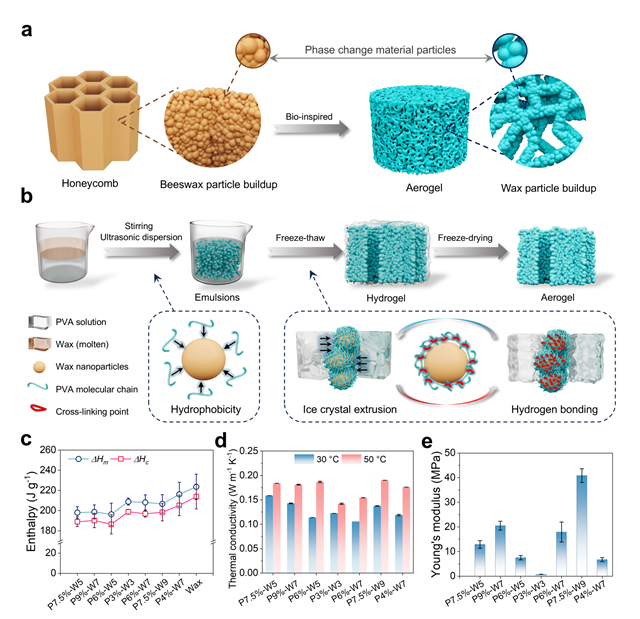
The study conducted simulations to verify the temperature regulation capabilities of this novel phase change aerogel in buildings. It was found that the phase change aerogel, based on an integrated "insulation + heat storage" mechanism, achieved nearly constant temperature regulation for up to 24 hours, significantly outperforming commercial aerogels.
Additionally, this phase change aerogel possesses recyclability characteristics similar to honeycombs, laying a foundation for its sustainable application in construction, aerospace thermal protection, and cold chain logistics. This makes it a promising material for enhancing energy efficiency and sustainability in various industries.
Paper details:Biao Wen⊥, Lei Zuo⊥, Nannan Jian, Xiaoqiang Song, Boyuan Miao, Lijuan Zhao, Yunfeng Zhao*, and Kai Zhang*. Beehive-Inspired Aerogels with Self-Assembled Phase Change Walls for Thermal Regulation. ACS Energy Letters, 2025, 10, 6197−6206.

-
Zhongguancun Campus:
No 5 Zhongguancun South Street, Haidian District, Beijing
-
Liangxiang Campus:
No 8 and 9 Yards, Liangxiang East Road, Fangshan District, Beijing
-
Xishan Campus:
No 16 Lengquan East Road, Haidian District, Beijing